
Who buys standing timber near me in Ohio?
Sawmills and loggers do, but never deal with them directly
If you are asking who buys standing timber near you, the most common buyers are sawmills, loggers, and timber buyers who purchase timber on behalf of those mills.
That is the simple answer. The more important answer is understanding how those buyers are paid, and why that almost always works against the landowner.
Who actually buys standing timber
Standing timber is almost always purchased by one of the following:
Loggers who cut and deliver logs to a specific mill
Timber buyers who work directly for a sawmill
Independent buyers who regularly sell to the same one or two mills
In every one of these cases, the buyer’s primary loyalty is not to the landowner. It is to the mill that needs a steady flow of wood at the lowest possible cost.
This matters more than most landowners realize.
Sawmills, loggers and their buyers are not incentived to pay for value for timber
Sawmills make money by turning logs into lumber and selling that lumber at a profit. To stay competitive, mills must control their raw material costs. Standing timber is that raw material.
Because of this, mill buyers and loggers are rewarded for buying timber cheaply, not for paying landowners what the timber might bring in a competitive market.
Their incentives are clear:
Pay just enough to secure the timber
Avoid bidding wars with other buyers
Move quickly to lock up the sale
Protect the mill’s margins, not the landowner’s outcome
This does not require dishonesty. The system itself encourages low offers.
When a landowner contacts a single mill or logger, the buyer knows there is no competition. There is no reason to disclose veneer value, specialty markets, or higher paying alternatives if doing so would increase the price they have to pay.
How “near me” works against you
The phrase “near me” feels logical because timber is heavy and transportation is expensive. Buyers do tend to operate within a limited radius of their mills.
But proximity favors the buyer, not the seller.
A nearby buyer often has fewer competitors, lower hauling costs, and more leverage. That makes it easier for them to make conservative offers and still secure the timber.
In many cases, the closest buyer is the least motivated to pay aggressively, because they know they are the most convenient option.
Why standing timber is commonly undervalued
Standing timber is rarely inventoried properly by mill buyers or loggers making direct offers. Instead of a detailed breakdown by species, grade, and size, offers are often based on rough estimates.
This leads to several problems:
High value trees are averaged in with low value trees
Veneer logs are treated as sawlogs
Species with strong markets are undervalued
The landowner never sees how the price was calculated
Without transparency or competing bids, the landowner has no way to know what their timber is actually worth.
Who landowners should involve instead
Landowners who want fair market value for standing timber typically work with a consulting forester.
A consulting forester does not buy timber. They do not work for sawmills. They are hired to represent the landowner’s interests.
Their job is to slow the process down and keep buyers honest by:
Inspecting and marking only the appropriate trees
Creating a detailed inventory of the timber being sold
Identifying all qualified buyers in the region
Forcing buyers to compete for the timber
Competition is the single biggest factor in getting paid well for standing timber. Sawmills and loggers pay more when they have to.
How to answer the “near me” question the right way
If you are searching for who buys standing timber near you, the better question is who can expose your timber to all of the buyers who operate in your region, not just the closest one.
We help landowners do exactly that by connecting them with ethical consulting foresters who understand local timber markets and buyer behavior. This approach removes the buyer’s home field advantage and replaces it with a controlled, competitive sale.
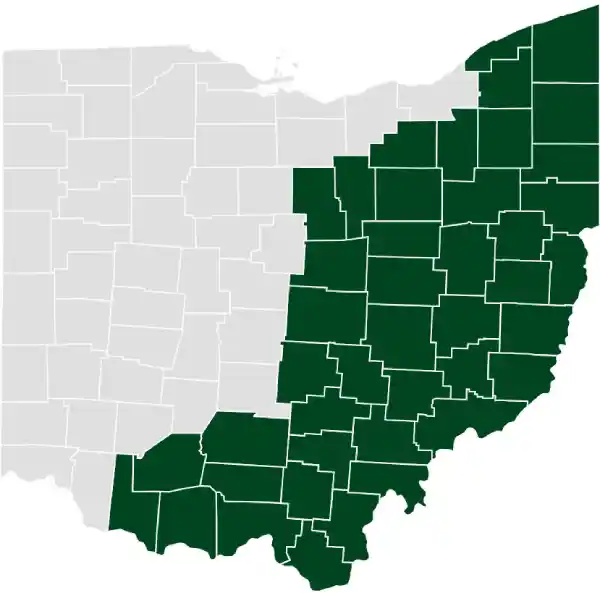
We can get you top dollar for your timber in all of these 57 Ohio counties.
You can see proof of the results we get in these recent timber sales.
Final thought
Yes, sawmills, loggers, and timber buyers near you buy standing timber. But they are structurally disincentivized to pay landowners well.
If your goal is maximum value, accountability, and clarity, the solution is not finding the closest buyer. It is making buyers compete for your timber under terms that protect you, not them.
- Minimum: 10 wooded acres or 50 mature trees.